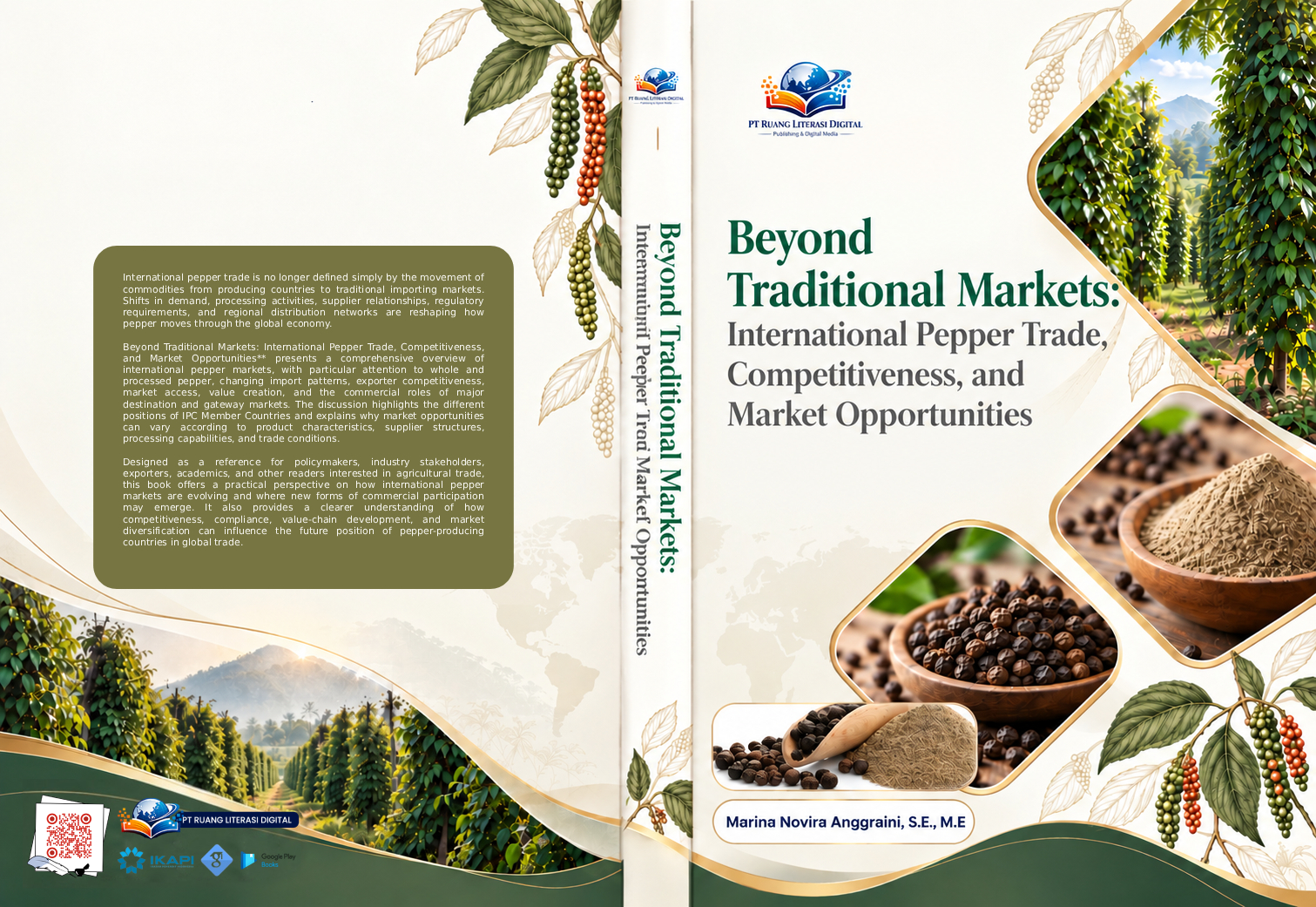
Cover Buku
Draft Publik
Nonfiksi - Monograf
Draft Publik.
Halaman ini tersedia untuk keperluan verifikasi/administrasi.
File PDF belum tersedia untuk publik.
Beyond Traditional Markets:
International Pepper Trade, Competitiveness, and Market Opportunities
Penulis
Marina Novira Anggraini, S.E., M.E
Penerbit
PT Ruang Literasi Digital
Tahun Terbit
-
ISBN
-
Jumlah Halaman
122 halaman
Harga
Rp 99.500
Beli via WhatsApp
Preview PDF belum tersedia
Abstrak
Beyond Traditional Markets: International Pepper Trade, Competitiveness, and Market Opportunities examines the changing structure of international pepper trade and the conditions under which commercially relevant market opportunities emerge for pepper-producing countries. The study moves beyond conventional assessments based primarily on the size of importing markets by integrating international demand, physical import growth, product composition, exporter positioning, supplier concentration, market penetration, tariffs, rules of origin, regulatory requirements, processing capabilities, and international distribution networks. Particular attention is given to India, Indonesia, Malaysia, Sri Lanka, and Viet Nam as member countries of the International Pepper Community, while competing origins, processing centres, and gateway markets are incorporated where necessary to explain global competitive dynamics. The analysis distinguishes whole pepper under HS 090411 from crushed or ground pepper under HS 090412 and primarily uses international trade data from 2019 to 2024, supplemented by market and regulatory information available through September 2026. The book introduces the IPC Pepper Market Opportunity Index as a comparative framework combining Destination Market Attractiveness, Exporter Positioning, and Market Access Feasibility. It further examines established, growth, emerging, gateway, and member-specific markets; differences in export structures among producing countries; tariff and non-tariff market-access conditions; food-safety requirements; processing and product differentiation; traceability; direct sourcing; buyer relationships; and supply-chain resilience. The analysis demonstrates that market opportunity is exporter-specific rather than universal: the same destination may offer substantially different commercial prospects depending on product form, existing market penetration, processing capability, competitive structure, regulatory access, and buyer requirements. By integrating trade statistics with commercial and institutional analysis, this monograph provides a structured basis for understanding international pepper markets as interconnected systems of production, processing, distribution, compliance, and value creation rather than as a simple hierarchy of importing countries.
Deskripsi
Pepper has been traded internationally for centuries, yet the geography of production alone no longer explains where commercial value is created. Pepper may be cultivated in one country, processed in another, distributed through a regional trading centre, and eventually consumed in a different market. Producing economies can simultaneously become importers and processors, while countries with limited primary production can occupy important positions through processing, logistics, trading, and redistribution.
Beyond Traditional Markets: International Pepper Trade, Competitiveness, and Market Opportunities examines this increasingly complex international market structure. Rather than asking only which countries import the most pepper, the book considers a broader commercial question: where does demand intersect with exporter capability, competitive positioning, processing capacity, market access, and buyer requirements?
The opening chapters establish the changing landscape of international pepper trade and the conceptual foundations required to understand market opportunities. International demand, export competitiveness, product differentiation, value addition, global value chains, distribution networks, and market-access feasibility are presented as interconnected dimensions of international market participation.
A central feature of the book is the analytical framework used to compare international pepper markets. Destination-market attractiveness is assessed through market size, physical import growth, trade-value growth, recent momentum, import stability, and relative unit values. These demand-side characteristics are then considered alongside exporter positioning and market-access feasibility. The resulting IPC Pepper Market Opportunity Index provides a structured means of comparing commercial conditions without treating its numerical results as automatic prescriptions for export decisions.
Whole pepper and processed pepper are analysed separately because they frequently operate through different commercial channels. Whole pepper may be imported for cleaning, grading, grinding, blending, packaging, or redistribution, while crushed or ground pepper can enter food manufacturing, food service, retail, and industrial supply chains more directly. Changes in one product category therefore do not necessarily indicate comparable changes in the other.
The empirical discussion illustrates how international demand evolved between 2019 and 2024. Major established destinations continue to account for substantial trade, but important changes are also visible across smaller markets in Asia, Europe, the Middle East, Africa, and other regions. Germany and South Africa illustrate situations in which processed-pepper imports expanded while whole-pepper imports declined, whereas Canada experienced development across both categories. Saudi Arabia recorded considerable growth in whole and processed pepper, while gateway economies such as the Netherlands and Singapore demonstrate the commercial significance of processing and redistribution networks.
The book pays particular attention to the different competitive positions of IPC member countries. Viet Nam combines substantial export scale, broad geographical coverage, and considerable involvement in processed products. Indonesia maintains extensive participation in whole-pepper markets but a considerably smaller processed-pepper export base. India has meaningful capabilities in both product forms, although its penetration varies significantly across destinations. Sri Lanka maintains a particularly strong relationship with the Indian market, creating both commercial strength and geographical concentration. Malaysia operates from a smaller export base while retaining established positions in selected Asian markets.
These differences show why a single global market ranking cannot adequately describe commercial opportunity. A destination in which one exporter already holds a dominant position may still offer significant room for another. Conversely, low market penetration does not automatically indicate an easy opportunity, since weak participation may reflect regulatory barriers, product incompatibility, logistics, established suppliers, or buyer preferences.
Market access therefore forms another major component of the analysis. The book examines tariffs, preferential trade arrangements, rules of origin, sanitary and phytosanitary requirements, food-safety regulations, import procedures, facility registration, documentation, inspection, testing, and border controls. Preferential trade agreements are shown to be commercially meaningful only when the relevant product qualifies, applicable rules of origin can be satisfied, and exporters can meet administrative and regulatory requirements in practice.
The comparative discussion of international markets reveals several distinct commercial structures. Germany combines substantial demand with processing and redistribution. France displays stronger links to domestic consumption and food manufacturing. The Netherlands functions as an important European gateway. Canada combines whole- and processed-pepper demand with North American processing networks. Australia and the Republic of Korea show strong relationships with Asian suppliers, while Mexico illustrates the coexistence of domestic production, exports, imports, supplier concentration, and preferential trade arrangements.
The book subsequently moves from market participation to value creation. Pepper trade involves more than agricultural production. Cleaning, grading, sterilisation, grinding, blending, packaging, quality assurance, certification, traceability, logistics, inventory management, financing, and distribution can all contribute to commercial value. However, additional processing is not automatically more profitable. Value addition becomes meaningful when processing capabilities correspond with identifiable buyer demand and when the resulting commercial return justifies the additional cost.
Food safety and compliance receive particular attention because they influence both regulatory access and commercial relationships. Consistent control of residues, microbiological hazards, traceability, processing conditions, documentation, and product specifications can strengthen buyer confidence. In this context, regulatory compliance is not merely a minimum requirement for entering a market but can become part of an exporter's competitive capability.
Direct sourcing, intermediary relationships, and gateway markets are examined as alternative ways of organising international commercial relationships. Eliminating intermediaries is not necessarily the most advantageous strategy because traders and specialised importers can provide logistics, financing, inventory management, processing, quality assurance, regulatory expertise, and access to wider buyer networks. The appropriate arrangement depends on the exporter, product, market, and commercial functions required.
The final chapter considers the future of international pepper markets through changes in whole- and processed-pepper demand, producer-importer economies, gateway and regional distribution networks, food-safety regulation, supplier concentration, logistics, and supply-chain resilience. The book identifies several strategic directions for producing countries, including strengthening established markets, selectively developing growth destinations, linking processing investment to identifiable demand, improving product differentiation and compliance, using gateway markets strategically, reducing excessive market dependence where appropriate, and continuously updating market intelligence.
This monograph is intended for researchers, academics, agricultural economists, international trade specialists, policymakers, commodity organisations, exporters, processors, market analysts, and other stakeholders involved in the international pepper industry. By linking quantitative trade information with market structure, regulatory conditions, competition, product differentiation, and commercial relationships, the book provides a framework for understanding not simply where pepper is traded, but how and where opportunities for market participation and value creation are emerging.
Beyond Traditional Markets: International Pepper Trade, Competitiveness, and Market Opportunities examines this increasingly complex international market structure. Rather than asking only which countries import the most pepper, the book considers a broader commercial question: where does demand intersect with exporter capability, competitive positioning, processing capacity, market access, and buyer requirements?
The opening chapters establish the changing landscape of international pepper trade and the conceptual foundations required to understand market opportunities. International demand, export competitiveness, product differentiation, value addition, global value chains, distribution networks, and market-access feasibility are presented as interconnected dimensions of international market participation.
A central feature of the book is the analytical framework used to compare international pepper markets. Destination-market attractiveness is assessed through market size, physical import growth, trade-value growth, recent momentum, import stability, and relative unit values. These demand-side characteristics are then considered alongside exporter positioning and market-access feasibility. The resulting IPC Pepper Market Opportunity Index provides a structured means of comparing commercial conditions without treating its numerical results as automatic prescriptions for export decisions.
Whole pepper and processed pepper are analysed separately because they frequently operate through different commercial channels. Whole pepper may be imported for cleaning, grading, grinding, blending, packaging, or redistribution, while crushed or ground pepper can enter food manufacturing, food service, retail, and industrial supply chains more directly. Changes in one product category therefore do not necessarily indicate comparable changes in the other.
The empirical discussion illustrates how international demand evolved between 2019 and 2024. Major established destinations continue to account for substantial trade, but important changes are also visible across smaller markets in Asia, Europe, the Middle East, Africa, and other regions. Germany and South Africa illustrate situations in which processed-pepper imports expanded while whole-pepper imports declined, whereas Canada experienced development across both categories. Saudi Arabia recorded considerable growth in whole and processed pepper, while gateway economies such as the Netherlands and Singapore demonstrate the commercial significance of processing and redistribution networks.
The book pays particular attention to the different competitive positions of IPC member countries. Viet Nam combines substantial export scale, broad geographical coverage, and considerable involvement in processed products. Indonesia maintains extensive participation in whole-pepper markets but a considerably smaller processed-pepper export base. India has meaningful capabilities in both product forms, although its penetration varies significantly across destinations. Sri Lanka maintains a particularly strong relationship with the Indian market, creating both commercial strength and geographical concentration. Malaysia operates from a smaller export base while retaining established positions in selected Asian markets.
These differences show why a single global market ranking cannot adequately describe commercial opportunity. A destination in which one exporter already holds a dominant position may still offer significant room for another. Conversely, low market penetration does not automatically indicate an easy opportunity, since weak participation may reflect regulatory barriers, product incompatibility, logistics, established suppliers, or buyer preferences.
Market access therefore forms another major component of the analysis. The book examines tariffs, preferential trade arrangements, rules of origin, sanitary and phytosanitary requirements, food-safety regulations, import procedures, facility registration, documentation, inspection, testing, and border controls. Preferential trade agreements are shown to be commercially meaningful only when the relevant product qualifies, applicable rules of origin can be satisfied, and exporters can meet administrative and regulatory requirements in practice.
The comparative discussion of international markets reveals several distinct commercial structures. Germany combines substantial demand with processing and redistribution. France displays stronger links to domestic consumption and food manufacturing. The Netherlands functions as an important European gateway. Canada combines whole- and processed-pepper demand with North American processing networks. Australia and the Republic of Korea show strong relationships with Asian suppliers, while Mexico illustrates the coexistence of domestic production, exports, imports, supplier concentration, and preferential trade arrangements.
The book subsequently moves from market participation to value creation. Pepper trade involves more than agricultural production. Cleaning, grading, sterilisation, grinding, blending, packaging, quality assurance, certification, traceability, logistics, inventory management, financing, and distribution can all contribute to commercial value. However, additional processing is not automatically more profitable. Value addition becomes meaningful when processing capabilities correspond with identifiable buyer demand and when the resulting commercial return justifies the additional cost.
Food safety and compliance receive particular attention because they influence both regulatory access and commercial relationships. Consistent control of residues, microbiological hazards, traceability, processing conditions, documentation, and product specifications can strengthen buyer confidence. In this context, regulatory compliance is not merely a minimum requirement for entering a market but can become part of an exporter's competitive capability.
Direct sourcing, intermediary relationships, and gateway markets are examined as alternative ways of organising international commercial relationships. Eliminating intermediaries is not necessarily the most advantageous strategy because traders and specialised importers can provide logistics, financing, inventory management, processing, quality assurance, regulatory expertise, and access to wider buyer networks. The appropriate arrangement depends on the exporter, product, market, and commercial functions required.
The final chapter considers the future of international pepper markets through changes in whole- and processed-pepper demand, producer-importer economies, gateway and regional distribution networks, food-safety regulation, supplier concentration, logistics, and supply-chain resilience. The book identifies several strategic directions for producing countries, including strengthening established markets, selectively developing growth destinations, linking processing investment to identifiable demand, improving product differentiation and compliance, using gateway markets strategically, reducing excessive market dependence where appropriate, and continuously updating market intelligence.
This monograph is intended for researchers, academics, agricultural economists, international trade specialists, policymakers, commodity organisations, exporters, processors, market analysts, and other stakeholders involved in the international pepper industry. By linking quantitative trade information with market structure, regulatory conditions, competition, product differentiation, and commercial relationships, the book provides a framework for understanding not simply where pepper is traded, but how and where opportunities for market participation and value creation are emerging.